an ideal space on the frontier

maya.rouvelle Topolo 2015

click here for the complete set on Flickr

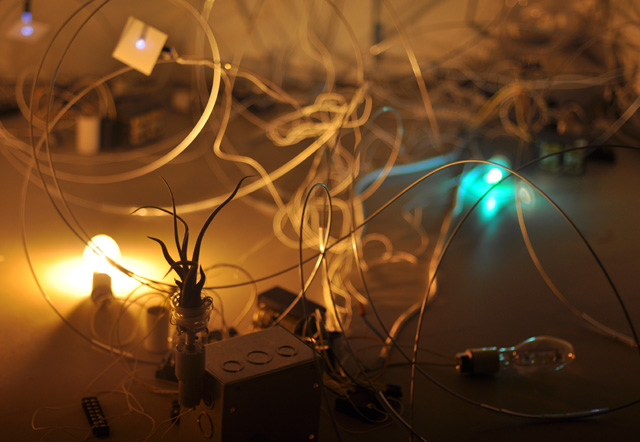
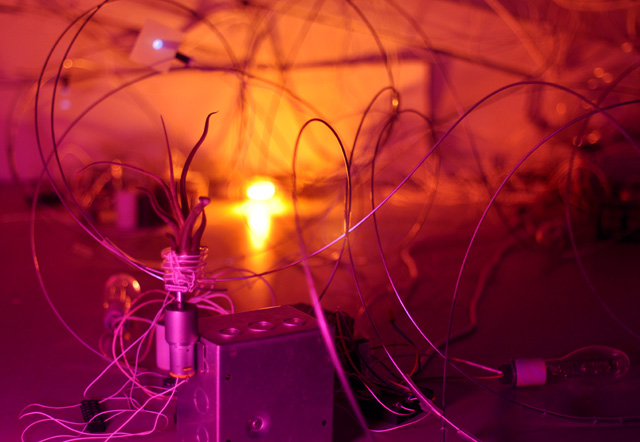
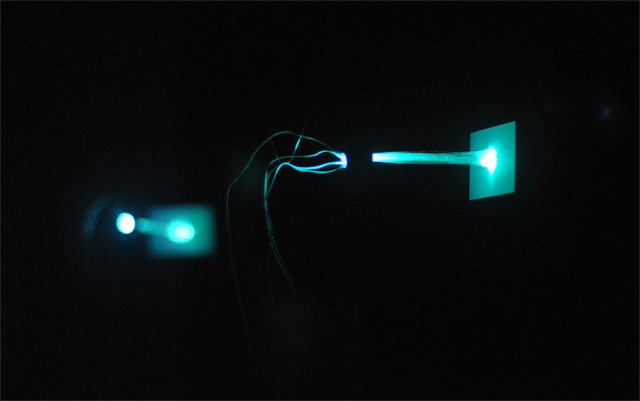
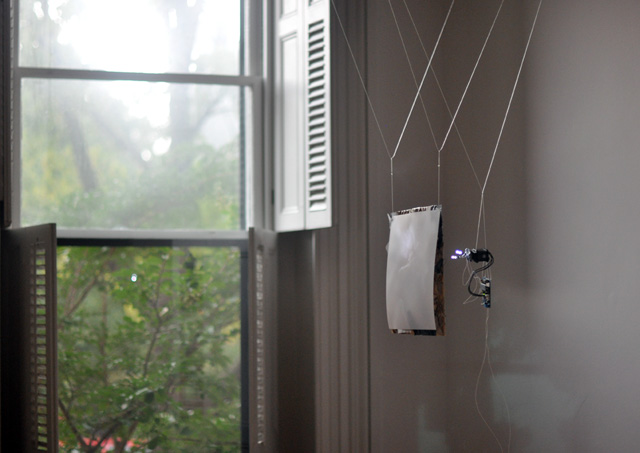
An ideal space on the frontier is a topology of events and media realized for Stazione di Topolò, July 2015. The work includes an installation/performance with mezzo-soprano Carlotta Buiatti, a musical composition, handmade musical instruments, materials found on site, drawings and video.

Inspired by the location and its history on the Italian and Slovenian border, Stazione di Topolò was an ideal space for us to continue to explore with sound, light and movement the qualities of suspension that take place on the frontier; where the essential in-betweenness of all things is evoked, with its ever present shifting perspectives, dualities and parallels.

As an installation/performance, materials (including objects found on site and media we prepared beforehand) were installed and open to the public. Performances in the space by us and mezzo-soprano Carlotta Buiatti were also scheduled, during which we would play a sound work composed of pre-recorded and live sounds made with the materials in the space. The performance would cause the materials/composition of the installation to be rearranged and would remain until the subsequent performance.

Materials: objects found on site, hand-made paper assemblages, drawings, video projection, sound (a pre-composed soundtrack of digital and analog sources, live performance on hand-made acoustic instruments, vocals by Carlotta Buiatti, cassette recorders) and programmed LEDs.

This video was developed on site and includes footage captured in Topolò as well as unpublished material from earlier maya.rouvelle projects whose content foreshadowed this work. The visual echoes between the Topolò footage and the previous work footage form an isorhythm across time and space, another frontier. As a part of the installation/performance the video was projected onto drawings positioned over found objects.

The musical composition is a cross-synthesis of different musics from different times and media organized around the theme of the project.

This video presents the work in its installation form. The accompanying sound is an edited version of the audio track that was part of the work (link above).
tiento

our electro-magnet setup in sunlight on a cloudy, winter day. we made a live performance incorporating this work and including some of our glass objects called ballade (below). here is a link to ballade and our other sound recordings on soundcloud.

ballade

live performance with handmade glass objects and electro-magnets. the electro-magnet setup appears on its own in ballade, the video and sound piece above, and with our other works on vimeo here.

pilchuck glass school residency documentation

mr1-18-w-be8-DSC04557

mr-40-w-pr7-DSC04552

click here for the complete set on Flickr

During our residency at Pilchuck Glass School, we expanded on work started at the Museum of Glass and we developed a series of new works involving sound making objects, printmaking and drawing. We gave two performances during our residency, and some of our printmaking was exhibited during November 2014 at the Pilchuck Glass School Exhibition Space. Additional documentation of our performances and print process are linked below.

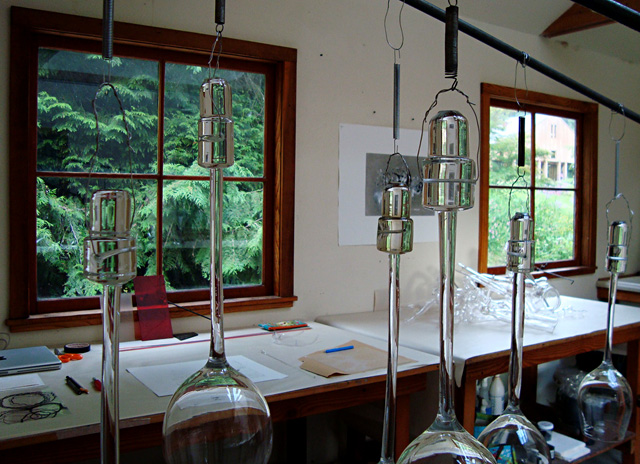
Our sound work with glass involves the creation of shapes that can be bowed or struck to produce fundamental pitches and harmonics so that one instrument can sound more than one pitch. Working carefully with our expert gaffers, Manny Krakowski and Netty Blair, we were able to make several variations of vessel shapes that each produced a complex spectrum of tones. We were also able to develop methods of linking two or more objects on a rocking base so that two objects could be played simultaneously by one player and variations on timbre and attack through bowing, striking, rocking were possible.

For our performances we grouped objects in terms of their tunings and timbres making tuning changes (by reshaping, or filling vessels with water) where necessary to create a specific temperament. Once we created a temperament we improvised extensively with it and developed compositions for it. Our compositions are a mix of rehearsed sections/gestures connected by improvisation. While we usually decide how to start and end, the pieces are largely determined during the performance.

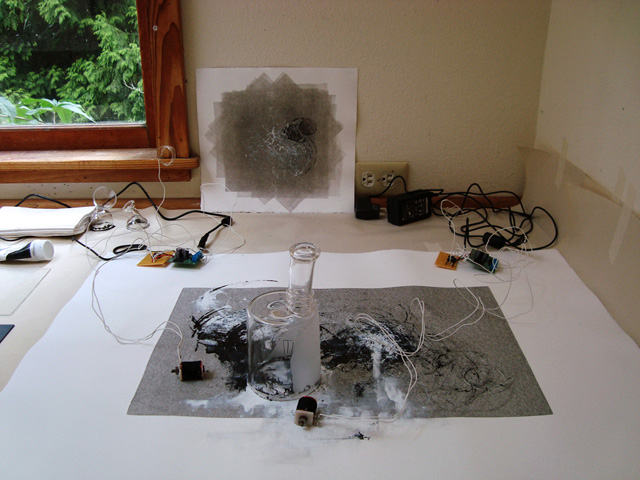
In both our sound and print work we used electro-magnet/neodymium magnet setups where the magnets moved in response to changes in the polarities of our electro-magnets that were triggered by fluctuations in the EMF of the space where they were.

As sound, the clinking/tapping of the magnets against glass added a percussive, chaotic element to our compositions; something that fueled our improvisations as the magnets never behaved the same way in each performance.

For the prints, we used the same set of circuitry, vessels and magnets, but as mark making elements. We set the magnets up on inked plates and let them roll until they were covered in ink and had left marks on the plates. We then made several prints with the plates, and then placed the electro-magnet setup on the prints’ surface in the same configuration and let the neodymium magnets deposit the ink they had previously gathered. Freshly inked magnets were also added in the process. As with the sound pieces, the electro-magnet’s polarity oscillates in response to changes in EMF around them.

Our drawings incorporate variations on the shapes of the goblet and the vessel, primary glassblowing forms that suggested to us the physiology of the inner ear. The drawings functioned as non-dimensional starting points for the development of our sculptural and sound making objects.

Our time at Pilchuck was special and we are grateful to the long list of wonderful people who made our experience so memorable including Tina Aufiero, Rebecca Arday, Jim Baker, Ben Wright, our gaffers Manny Krakowski and Netty Blair, our assistants Keunae Song and Anna Masowsky, Alex Gibson in the printshop, Rebekah Birkan, who constructed the amazing frame for the goblets from found metal in the Pilchuck metal shop and Zach Lorenzetti who made music with us and assisted behind the wheel!

à la vitesse de ton souffle

more details for the work are on the vimeo page.

Influenced by our time walking in and around Paris, La Générale and the jardins de Versailles, à la vitesse de ton souffle is an installation in the form of a sequence of compositions and spaces made of sound, light, objects and movement, activated by visitors walking through the gallery at the speed of their own breathing. Each composition oscillates and slips between various binaries: formal and semiotic, interior and exterior, found and placed, organic and artificial, operand and operator. à la vitesse de ton souffle is a perambulation in a twilight heterotopia of green and pink noise.

Influencés par le temps passé à nous promener dans et autour de Paris, La Générale et les jardins de Versailles, à la vitesse de ton souffle est une installation qui prend forme dans l’ordre des compositions et des espaces créés par le son, la lumière, les objets et les mouvements, activés par les visiteurs qui se déplacent dans l’espace à la vitesse de leur respiration. Chaque assemblage oscille et glisse entre diverses dualités : formel et sémiotique, intérieur et extérieur, trouvé et placé, organique et artificiel, opérant et opérateur. à la vitesse de ton souffle est une pérambulation dans un crépuscule hétérotopique d’un bruit vert et rose.

au concert printemps flottant

maya.rouvelle paris

mayarouvelle palais de tokyo

au concert printemps flottant was shown at the palais de tokyo as part of concert hall, a large collaborative work included in nouvelle vagues.

au concert printemps flottant is a kinetic installation composed of organic and industrial materials, including a live tillandsia medusa, a custom LED grow light, a motor, and commercial gas vapor street lights, among other materials. a micro-controller regulates movement and changes in lighting intended to both sustain the tillandsia and reveal a sequence of 26 short variations in movement and light over 11 minutes. au concert printemps flottant was built and programmed on-site during the installation period for nouvelle vagues’ concert hall and was influenced by, and references, the themes of music, play and integration at the heart of this exhibit.

the materials include: tillandsia caput-medusa, electronics, plastic tubing, metal springs, custom electric light, vellum, wood, paint.

the dimensions of the work are approximately 10’x20’x15′.

for the flickr set click here.

die Botschaft 1628, a private gallery

mottetto detail

quine

we have a show at a private gallery in baltimore, md, called die Botschaft 1628, owned by marcia hart. the show runs until september 23, features 6 new works and is available by appointment only. none of the work is for sale, there was no opening and no hype. we had several salon style discussions and visits with interested viewers.

prior to our show we weren’t aware of people dedicating parts of their homes to occasional, private art exhibits.

the experience has been wonderful. before this opportunity we began the summer developing several works with no idea where they would eventually be shown – happily devoting our time to our work and process. in may we met marcia and visited die Botschaft 1628 and had a few subsequent discussions over the summer that lead to the opportunity.

we structured our time as a residency with an accompanying exhibit. we completed the works begun in our studio on-site, conditioned by the gallery and after the works were completed, were able to spend mindful time with interested visitors and get their feedback. we gave a few gallery talks to small groups and had easy access to the space while managing when visitors would be there. we were able to visit the work privately to look at it installed at different times of the day (the gallery has two large windows so the lighting conditions change dramatically), document and learn from it.

the title we chose for the show was: a silent evocation of the society for private musical performance – a reference to the salon chamber music society of vienna in the early 20th century. that society was designed to permit a diverse array of new concert music the chance to be heard in an educated, critical environment of careful listening and thought (often works were performed twice on the same evening) as a foil to mounting public and journalistic confusion of popular trends, entertainment and privilege with art that were contributing to a harsh environment for the evolution of music as an art form.

our time at die Botschaft 1628 has shown us an ideal exhibition paradigm for our art practice and process, and we’ll leave the gallery focused and inspired. we’re writing about this because there may be others out there who feel similarly, either potential private gallerists or artists and this may serve as an impetus to a deeply rewarding experience.

we’ll be posting documentation of our work here in the coming weeks.

Published
Categorized as projects